I was drowning in my own achievement until I learned the difference between being loved and being needed.
This is the story of how I built the perfect life, nearly lost myself in it, and discovered that the love I was performing for was never the love I actually needed. This is the introduction chapter to BLOOM.

I want to start with a love story.
Not because mine is more interesting than yours. It is not. But because a love story is how we understand something that otherwise feels abstract, and because my story is the reason I know what I know. Every principle I will teach you in this book was forged on the floor of a life that had fallen apart, and rebuilt from the ground up by a woman who finally, finally, chose herself.
That woman is the one I want you to meet first. Not because you need to know my story. Because you need to know what is possible.
The girl before the woman
To understand a love story, you have to go back to where the themes begin. Not to the love itself. To the soil it grew in.
My mother came from an abusive family. She ran away, into an abusive relationship, and ran away from that too. She ended up in a small flat on the edge of the playing fields of an all-girls school in Reading, doing secretarial work, living with her cats, without much money to rub together. From her window she watched girls in red cloaks play a strange game on the fields. She said to herself, if I am ever lucky enough to have daughters, I will send them there.
I went to that school. My sister went to that school. My mother watched it happen from the other side of the playing field, and she made it real.
That was my first experience of visualisation. Of faith. Of trust in something bigger than the circumstances you can see. Before I had the language for any of it, my mother was showing me how it was done.
She also died on the operating table giving birth to me, and was brought back. My father was not allowed in. Someone came out and told him to go and have lunch. He walked past the theatre and later said it looked like a bloodbath. That was my mum. That was me. Fighting for our lives.
Years later, doing energy work with a healer, my body gave me back what my conscious mind had never known. I felt the abandonment in the womb. I felt my mother was going to leave me, and so I learned, before I ever drew breath, to will her to stay. To please her. To be good. To be thin. To achieve. To do whatever it took to keep her with me.
That pattern would shape almost every relationship I had for the next forty years.
My mother loved me fiercely. Scarily. Protectively. She also looked like Twiggy, and she told me from a young age that I had the Brooks’ genes (paternal), that I could not eat what my sister could eat, that I needed to be careful, that I would get fat. She was proud of me when I achieved. She was proud of me when I was thin. The love was real. The conditions were real too.
My father instilled in me a work ethic that I still have today, grit & tenacity my middle names, words used in every school report or PDP. My sister was the clever one, the Davies genes (maternal). I was a Brooks. I had to work hard for everything. When I got double scholarships, the house celebrated. When I phoned home from Australia to tell them I had been given a golden handshake and every partner endorsement to join the biggest consultancy in the world, my parents danced in delight.
That was how I learned my worth. Achievement. Approval. A small body and a large salary. A gold star on every piece of paper. I did not question any of it. Why would I? It was working. I was loved. I was celebrated.
The boy in the grey salopettes
My husband, James is my best friend from uni, Pippa’s, brother. In 1996, she organised a ski trip, and younger siblings came along. There was no snow. There were twenty-one of us in a chalet meant for twenty-four. We drank like teenagers, because we were teenagers, and I still feel sorry for the three unfortunate strangers who had to share the chalet with us.
One morning a huge snowstorm came in, and Pippa said, come on, we have to go up. In the days before mobile phones and tracking, the rule of thumb, no one skied alone. If one went, we all went. We went up through the cloud, got to the top, and the twenty-one of us scattered.
I was useless at maps, hungover, and I have never coped with hangovers. I decided the safest plan was to follow somebody down. In the white out of cloud and snow, I spied a nice bottom in a nice pair of grey salopettes. I thought, I will follow that.
We got to the bottom of the mountain, to the lift queue. He lifted his goggles. I lifted mine.
It was James. My best friend’s brother.
We skied together the rest of the day. We kept finding excuses to see each other for the rest of the trip. We did not tell his sister. Pippa only found out we had our first intimate moment on that holiday during the Mr and Mrs questions at our hen and stag weekend, years later!
After university we travelled for six months before we moved to London. Thailand, Malaysia, Singapore, Australia, New Zealand, Fiji, Hawaii, Canada, America. Before mobile phones. Before proper internet. Just us, the world, and a big travel book and, of course, my journals and a camera with plenty of film.
Ten Australian cents
The only time we argued was over ten Australian cents.
James, who is still an accountant, had budgeted every penny of that trip. We were trying to get from Noosa to Sydney and we did not have enough for another hostel, so we took the overnight Greyhound. Neither of us slept. We arrived in Sydney not on our best form. We needed to ring his cousin Carl to tell him which ferry we would be on to Manly. The conversation went like this:
Have you got ten cents?
Yeah, I’ve got ten cents. Have you got ten cents?
Yeah, I’ve got ten cents.
Well, let’s use yours.
I’m not using mine. Use yours. He’s your cousin.
A blazing row. Over ten Australian cents!
I walked off. I sat for five hours in a coffee shop I could not afford a coffee in. I rang my sister at three in the morning her time and told her I had lost my boyfriend in Sydney and we had argued about ten cents. She asked, lovingly, if she could call me back later.
Eventually I pulled myself together. I thought: the next step is to get on the ferry to Manly. I will get on the ferry.
As I came into Manly Harbour, there was James.
Standing there. He had been standing there for five hours. Because he did not want me to be lost.
In that moment, I thought: this is the guy I am going to marry. He waited. He did not have to. But he waited.
Twenty-five years later, when everything had fallen apart, when I could barely walk across the kitchen without my legs giving way, I would remember this. I would need to remember it. Because the question I was being asked, in the dark, was whether the man on Manly Pier was still inside the man who had broken me. And the answer, in the end, was yes.
But I am getting ahead of myself.
Three shooting stars
Fiji came next. We arrived just as George Speight had overthrown the government, and there was almost no one there. We had the most magical two weeks of our lives. Empty beaches. Incredible dives. A world that felt like ours alone.
One night I sat on the beach while James and the others drank kava. No light pollution. A sky so vast it felt like you could fall into it. Three shooting stars fell across my line of sight in a perfect triangle, and I wished on all three.
I wish James and I live happily ever after. I wish we are truly happy. I wish we have a long and happy life.
Twenty years later, during a meteor shower on a beach in Polzeath, just emerging from the darkest period of my life, I looked up and wished on those stars again.
Please let us live a long and happy life, despite everything.
I share this because the word that matters is despite. Love, the real kind, is not about the absence of shattering. It is about what you choose to build after the shattering has happened.
The life on paper
We moved to London. We moved into our own flat. Everybody else got married before us. I waited eight years for James to propose, because he needed his ducks in a row and his accountancy exams completed. When he finally did, it was perfectly imperfect, original and funny, including helicopters, lions eyes, a diamond story and one of our best friends sleeping at the end of the bed. We married at Christmas. He sat his last paper four days before the wedding. We moved to Yorkshire soon after, because that had always been the plan.
I was a consultant at Accenture, commuting back to London, working on the early days of e-commerce. Home delivery. Multi-channel. Very exciting, fast moving, nice pay cheques, even nicer bonuses and I felt like a high-flyer. Then I lost a baby. I was standing up in front of very senior people, trying to explain how to repackage doors and drawers for home delivery in a world totally new and not set up like it is today, and I just started crying. My boss calmly pushed me out of the door.
That was my first real experience of grief, and of suppression, and of knowing, in my body, that having to suppress grief is a terrible thing.
I had three months of gardening leave and some extraordinary counselling provided by Accenture. At the end of it, I realised I did not want to travel any more. I wanted to start a family, make a home, be a Mum and a wife, which had always been my only dream as a girl.
Tom came, born not breathing, a true angel bringing light on the shortest day of the year. Our angel. We lost another baby the night of Pippa’s wedding. Willy came, my gorgeous little barrel, resisting the party of life until the very end when it was almost over (something he still does today!). We lost another, unexpectedly.
We lost three babies to have the two most beautiful sons of my life.
And still, I kept working. Dropping the boys at nursery at seven, racing into Leeds, racing back to collect them just before closing time, always the last mother at the gate along with my friend Helen. By now I was with Walmart Global e-commerce, running teams across America, Leeds, and Sofia Antipolis. Round the clock. All over the place. I missed a key moment of Tom’s schooling once and I was inconsolable.
I had been told I could have it all. The high flyer. The mother. The perfect family life. On paper, we did have it all. Two gorgeous sons. A beautiful home. An amazing social life. Everything.
And I was miserable.
Life on paper sounds good, but living it at the time, wasn’t. You can build it exactly the way you were told to, hit every milestone, tick every box, and arrive somewhere that does not feel like you at all. That you can be drowning in your own achievement. That the gold stars, stacked high enough, become a wall between you and the life you actually wanted, the dream you actually believed in.
The night I pressed send
I came home one night, raced in, got the boys into bed, started reading the story. You know when you are reading and you flick two pages at once, and they say, Mummy, you missed that page, and you think, but I have got to sort dinner, and you go back, and you resent it, and you are not really with them, and then you feel guilty for not really being with them.
I needed to get downstairs. James would be home wanting supper, because I was also meant to be the perfect wife. The pots were boiling over on the hob. Willy came down and said, Mummy, I have done a poo in my nappy. James walked in through the back door, the puppy was sick in the middle of the kitchen floor.
I said to him: supper is two minutes away, Willy has done a poo, the dog has been sick, and I have to get on a two-hour conference call with my team in America.
I left James there. With the sick, and the poo, and the boiling pans. Two hours later I came back from the office and from the call.
He just said:
Are you ready to write your resignation, or shall I?
In that moment I knew he was right. I had to look after me. I had to look after him. I had to look after our family. I was completely and utterly burnt out.
I pressed send.
The next day I walked into the office and told my boss. Six months earlier, my previous boss, a woman I admired greatly, who had taught me the real power of true coaching, had been diagnosed with breast cancer. Maybe that was the seed. I thought: do I want to get sick, and not have seen my boys, just for being in the office, for a paycheque, for a title, for an achievement I never signed up for?
My boss asked if I was sure. I said, absolutely. I asked if I could tell my team myself. As I walked back to my desk, two very senior men ran down the corridor after me, calling, Ali, Ali, Ali, you need to leave now. I think they were frightened of where I would go and share all my wisdom from working with a big retailer in a cut throat industry. I did say goodbye to my team. There were a lot of tears. And then I was out.
In hindsight, I wasn’t failing, even though it felt it at the time. It took courage to walk away from something that was no longer working.
I did not know it yet, but I had just taken my first real step into loving who I was. Because I had just stopped performing who I was supposed to be.
Goodbye, Mum
My mother had been diagnosed with Alzheimer’s just before we got married. By now it was getting bad. She knew who we were, but so much of her was leaving. My father was a full-time carer. My body kept getting ill, because my body was forcing me to stop.
I used the time after I left corporate to look into Alzheimer’s, health, and longevity. A friend handed me The Secret. I read it in one sitting and thought, why has nobody ever told me any of this? Why are we not teaching this in school? That book cracked something open. Personal development. Holistic health. The Secrets of the Universe and Laws of Attraction, Vibration and frequency. The idea that the way I had been living was not the only way.
My mother got worse. She reached the point of coming at my dad with knives. She was sectioned and taken to a mental hospital. In the home, she managed to secrete a knife and go at the key workers and the other patients. My gorgeous, glamorous, ‘Twiggy look alike’ mother, suddenly in a drug-induced straitjacket. I would come home and be physically ill from the sadness of seeing her like that.
Just after my fortieth birthday, she was moved into a beautiful palliative care home. I walked in and she was like a little bird, wrapped up in a chair. My Australian godmother was there. I sat with her. She could not really talk any more. I fed her pureed carrot. I remember it being orange.
When it was time to go, I took her hands and held them to my face.
Mummy. I love you.
And she said:
I love you too.
She had not spoken to me or properly looked at me for a long time. I walked out and looked back and said, Love you, Mummy. She had already gone, glazed over again. That was the last time she ever spoke to me.
The next morning, driving home, my friend Caroline phoned. She had picked up Tom. His right leg was the size of a football. He had a history of not registering broken bones, and had walked down to the school pool on it. It was broken from a malicious football tackle in to the metal railings. Like a champion, he didn’t want to make a fuss. Or the adrenalin just overrode his pain.
The next day, my father rang. Mum had pneumonia. It was end of life.
I looked at James. I said, I have to go and be with my mum. He was on childcare and animal duty as I drove 300 miles south.
I sat with my father and my sister for seven days. We did crosswords. We coloured in. I curled my sister’s hair. We listened to podcasts. We talked to Mum, friends came to say their goodbyes and because friends who had lost parents had told me: leave the window open so they can leave, and keep talking to them so they can hear.
At one point she was gagging on phlegm, choking, refusing to go. My sister and I sat there saying, Mummy, please go. Please be at peace. We love you. We want you to go. She would not go.
On the seventh day her toes got cold, which we had been told usually meant she was on her way. By eleven at night we were exhausted, and the staff said they would ring us. We went home. At half past one in the morning, the phone rang. She had just passed. She had hung on to the day of her 43rd wedding anniversary to my Dad.
Her final act of love for him.
I still cannot paint my toenails red. The last thing I remember of my mother being carried out to the body bag was her red toenails.
The six months that followed were brutal. Grief is not a cycle. It is waves crashing. I had been journaling gratitude for a while by then. I had taught myself to meditate. Through those six months, mindfulness was the only thing that kept me sane, because I could not imagine a life without my mother. So I lay underneath the trees and looked at the leaves and tried not to think. That was my practice.
I know now that she was preparing me for what came next. I did not know it at the time. But my mother, in her dying, was teaching me the last thing she had left to teach.
How to survive the unsurvivable. How to keep breathing when the ground has gone. She was teaching me to live through a storm, one breathe at a time.
The dark
Towards the end of that summer, James changed jobs, moved back to Yorskhire after living for a year in London during the week and the mood lightened. Joy was coming back. We watched Inside Out and I wrote at the time that Joy was back at the helm of our lives.
And then strange comments started appearing on my blog and social media. Messages I could not quite understand. On a Monday night after tennis camp, my phone went ping, ping, ping, ping, ping, ping.
After that, I do not remember much.
(The moment that changed the trajectory of my life - and the three visualisation techniques that made it possible - continues below for paid subscribers...)
The lights went off. My world came down around me. I have blocked out most of the detail, which I suspect is a mercy. The truth of my relationship was revealed. It wasn’t as rosy as I had believed. And the world went black.
I had been abandoned. Again. By the one person who was never supposed to.
I was diagnosed with clinical depression. I was diagnosed with PTSD, because I have a photographic memory, and although I deleted every image and message I received, I could still see every single one of them on a loop. Any word, any sound, any smell could trigger them.
I did not sleep. I could not eat. I lay in bed and I tried to understand something that made no sense.
But I remember a few things from that darkness, and those are the things I want you to have.
I remember, when the tears had finally stopped for a moment, James, through his own tears, saying:
I know you will not believe a word I say. But I am sorry. I have made the biggest mistake of my life. I will spend the rest of my life proving to you, and to the boys, that I mean it. I will do anything to make you happy for the rest of your life.
In that moment, my Manly Beach James was back. And over the next four years, he would wait for me, and do whatever it took, until I came back to him.
I remember friends coming in through the back door without knocking. Lying in bed with me. Not speaking. Just holding my hand. They did not know what had happened. They just knew something very bad had, and they came.
I remember one of them sending me a message that said:
The Japanese art of mending broken pottery is to line the cracks with gold. Kintsugi. You can put your life back together and make it more beautiful than it was before.
I took that and I held it like a torch.
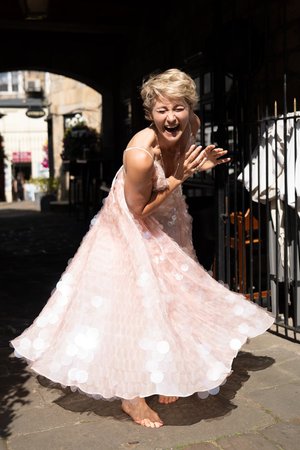
And I remember lying on my bed, in the worst of it, and running a picture through my mind. Of me, barefoot, in a floaty dress, dancing in the most beautiful garden. I did not know who was with me. I did not know where it was. I just knew that joy was coming out of my heart and spilling all around me, and that I was going to live that way eventually.
I wrote in that journal, on the 11th of January 2017:
I don’t know the answers right now, and that’s okay. I’ve always liked to know my destination. I need to see the destination as happiness and joy, rather than to live with or without him.
That was the first time I made myself the destination. Not the marriage. Not the reconciliation. Not the separation. Me.
And that is when my reality started to transform before my eyes.
The garden
In the first three months, I knew I could not stay. There was no way. I made plans to move near the boys’ school. I found divorce lawyers. I started walking down the path of separation.
In January, on my birthday, I went to London to see my oldest friends. They held me up. While I was there, James rang. He had found a house. He said:
I know you don’t want a future with me. But I have to think of the boys, and of us. I’m going to buy it. It needs a huge amount of work. I’m going to spend all my spare time building it. If at some point you believe me and want to come and live with me, I will have built this beautiful house for you and the boys. And if you don’t, that’s okay. We’ll sell it.
I came up to see it. I opened the front door and I felt peace. I walked round. I said, fine, there’s too much work here, but go ahead. I’m going to my modern flat in York.
Then we came out of the front door, and the owner asked if I wanted to see the garden. We went through a yew tree and down some stone steps.
And when they say, something can take your breath away - the prospect I looked at did exactly that - it took my breath away.
I walked out onto the grass. I took my shoes off.
It was the garden I had been dancing in.
The one I had imagined, night after night, in my worst weeks. The one I had held in my mind like a north star, my compass pointing towards it.
I turned to James, and I said: okay. I can see we could be happy here. I will give us a year.
I let go of the flat. We stopped the divorce. I said yes. Not because I had forgiven him yet. Not because I knew how any of it would work. But because I had already been there, in the garden, in the version of myself that had survived. And she wanted me to give it a chance.
This is what I want you to understand about visualisation, and about faith, and about the love story you are living right now. My mother watched girls in red cloaks across a playing field, and believed. I lay broken on a bed and danced barefoot in a garden I had never seen, and believed.
Neither of us knew how. We just kept the picture.
Smashed to smithereens
The house is significant because we bought it broken. It was a broken, run down, worn out house. We were broken hearted, emotionally spent. Everything was broken, needing care and attention.
In some cases, it wasn’t just broken. It had to be smashed to smithereens, because it needed to be. It had all been going in the wrong direction. We wanted a life that was true to us, and we were not living one. So, it had to be irrevocably shattered to the ground, so we could have the chance to build it back up from the roots, from imagination, to blueprint, to foundation and moment, by moment.
We did the same with the house. Stripped it back to the wiring. Replaced the plumbing. Rebuilt walls, layer by layer, brick by brick. We did the same with our marriage. Our marriage counseller who performed a miracle. Non-negotiable conditions on James’s part to understand why, so it could never happen again. A new therapist for me, to understand why I had stayed so small, so accommodating, so terrified of being left that I had made myself into someone I did not recognise. A new identity for both of us.
And on the other side of that work - not clean, not quick, not without moments of wanting to run - we had a marriage that was, for the first time, actually ours. Not the one inherited from his parents or mine. Not the one everyone expected. Ours.
There’s a quote about the end of a relationship, even if you’re in love, because it happens, and sometimes even if they hurt you, you love them, but you know it won’t ever be the same again. I originally thought that meant it would be too bad to be the same. But what if it meant it wouldn’t be the same, because it would be better?
That was an entry from my journal, 13th of January 2017. I read it now and I think: that was the voice of the woman I was becoming, talking to the woman I still was.
Why I do what I do
When I moved into the broken house, I retrained in the work I had been doing from following my curiosity in holistic health, healing of the mind and heart, spirituality. I took a year long qualification in holistic health, life and nutrition coaching. I did further certifications for another year in Mindfulness and learnt to be a Meditation tutor. Every tool I had used to climb out of my pit, I wanted to hand to the women following me as a mentor who didn’t just know theory, but who had done the work to dig herself out, knowing what it took.
People ask why my clients get the results they get. I always give the same answer. I have been in that dark place. I have been at the bottom of the pit. So I can stand at the edge and say: I know. I have the first torch. I have the first spark. Do you want to try this? Do you want to come with me? You can trust me – I have been exactly where you are now and I see you, I believe in you.
I learned empathy from the friends who showed me empathy. I learned how to hold space because I have been held. I learned what it feels like to have someone check in on you every single day when you are drowning. I learned what it feels like to be inspired back to life by people who refuse to give up on you. And now I give all of that to the women I work with.
I am a holistic coach because I learned physical health through my mother’s demise and Alzheimer’s. I learned mental health through the loss of a career and an identity. I learned spiritual health through having to rebuild a self that could no longer live on gold stars and approval.
I know how to recreate an identity. I know how to recreate a life. I know how to dream again, because I have done it. I have let go of people who no longer served me. I have only let in those with the right energy. I have become, at last, the heroine of my own story instead of everyone else’s sidekick. And in becoming the heroine, I allowed James to become my hero again. Because he did exactly what he said he would do. He did not say it. He did it.
I was never the victim. He was never a villain. We were just two human beings have a VERY human existence, full of mistakes and with love as the greatest healer.
This is why I wrote one of my first programmes, ‘Love for Life’.
Because somewhere out there, there is a woman, perhaps many women, sitting at the bottom of her own pit, looking up at a life she does not know how to rebuild. There is a woman living the life on paper, drowning in her own achievement, wondering why none of it feels like hers. There is a woman who has been betrayed, or bereaved, or broken, or just quietly lost. And she is wondering whether love is still possible, for her, after everything.
It is. I promise you, it is.
But the love she is looking for is not the love she thinks she is looking for. It does not start with a partner. It does not start with fixing the marriage, or finding a new one, or earning her way back to worth. It starts with her.
It starts with becoming a love warrior.
Ready to write your own love story?
This isn’t just my story - it’s a roadmap. Every principle I teach was forged in the fire of a life that fell apart and was consciously rebuilt. If you’re ready to stop living someone else’s version of your life and start creating one that actually feels like yours, here’s how we can work together:
The Joy Rebellion - Join my beautiful community where broken becomes beautiful and surviving becomes thriving. Start here → Join the Joy Rebellion here
VIP Joy Rebellion - Everything above plus monthly 1:1 sessions with me. Because some journeys need a personal guide. Be a VIP here → Be a VIP JOY Rebel
Joy in HD™ - Master your Human Design blueprint and amplify your most powerful frequency. The system that turns self-knowledge into strategy. Learn more → Be Devoted to your JOY
Brilliance - 6 months of private mentorship. Body, boardroom, bedroom - because all three matter. For the woman ready to stop leaving herself until last. Apply here →Brilliance 1:1 Mentorship application